Romanian Deadlift Form: How to Hinge Without Rounding Your Back
Worried Romanian deadlifts will hurt your lower back? Here's how to hinge properly, how far down to go, and what to check across a set so your back stays where it should.
The Romanian deadlift is one of the best exercises for the back of your legs.
It’s also the one people most often ask about with a worried tone: is it bad for your lower back?
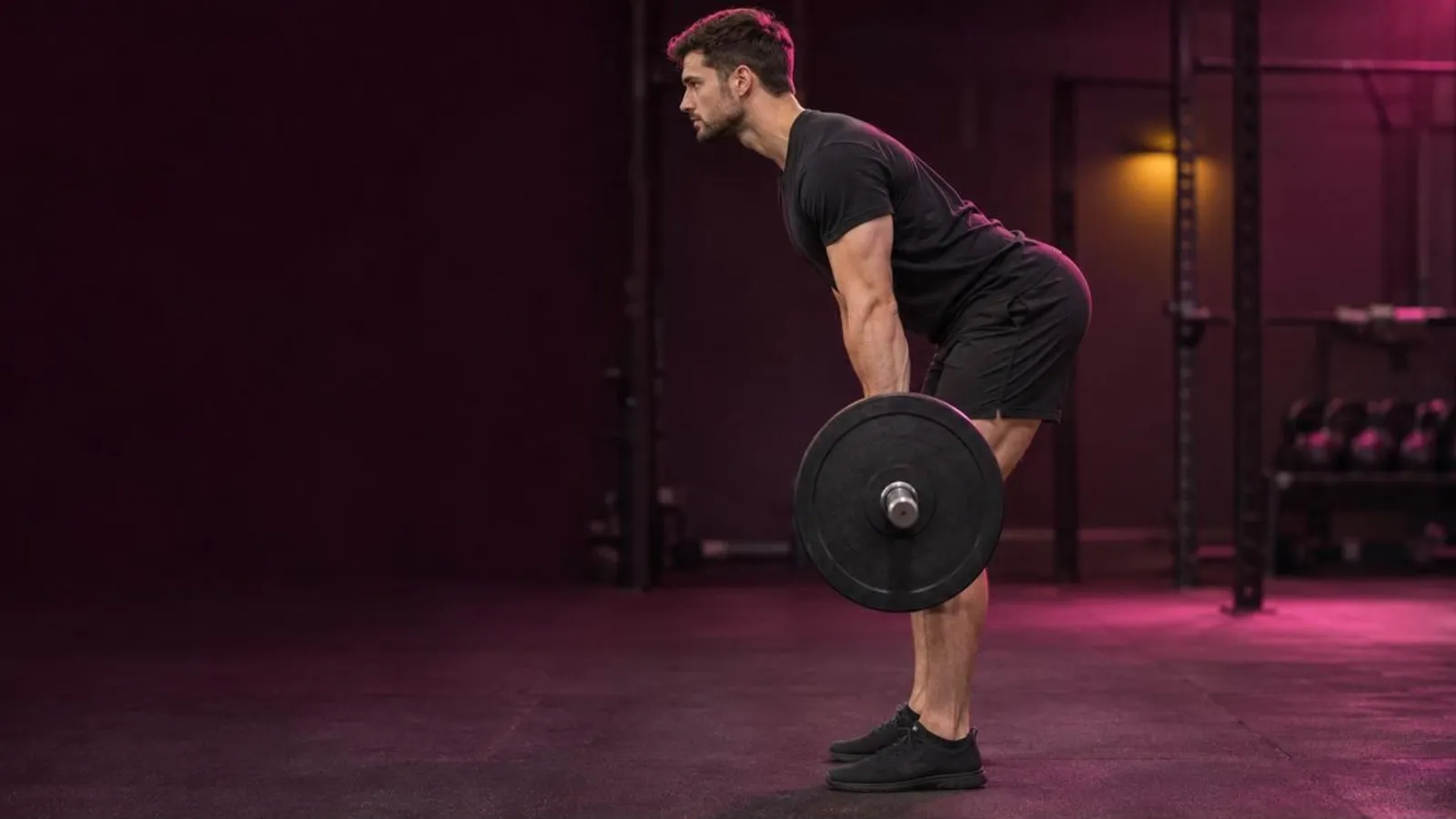
Done well, with a weight you can control, it isn’t. The Romanian deadlift is a hip hinge: your hips move back, your back stays in a neutral position, and your hamstrings and glutes do most of the work.
The problems usually start when the hinge turns into something else. The back rounds to reach lower. The bar drifts away from the legs. Or the knees bend so much it becomes a half-squat.
Here’s what good Romanian deadlift form looks like, how to hinge properly, and what to check across a set.
What is a Romanian deadlift?
A Romanian deadlift (often shortened to RDL) starts standing up, with the bar at your thighs.
From there, you push your hips back, lower the bar down your legs until you feel a strong stretch in your hamstrings, then drive your hips forward to stand back up.
NASM describes it as a posterior chain exercise that mainly works the hamstrings and glutes, with the muscles along your spine, your adductors and your upper back working to hold position.
Your knees stay slightly bent. Your back stays neutral. The movement happens at the hips.
How is it different from a conventional deadlift?
They share a name, but they’re different lifts.
Conventional deadlift:
- Starts with the bar on the floor
- Each rep begins from a dead stop
- Your knees bend much more at the start, so your legs push the floor away as well as your hips extending
- Usually trained heavier
Romanian deadlift:
- Starts standing, with the bar at your thighs
- The lowering phase comes first
- Knees stay softly bent and don’t change much
- The bar usually doesn’t touch the floor between reps
- More focused on the hamstrings and glutes, through a stretch
Think of it this way: the conventional deadlift picks a bar up off the floor. The Romanian deadlift lowers a bar from standing, as far as your hips and hamstrings allow, and back up.
That difference matters when you check your form. A Romanian deadlift that looks like a conventional deadlift, with deep knee bend and the bar touching down, has usually lost the point of the exercise.
1. Hinge, don’t squat
The single most important part of the RDL is the hip hinge.
In a squat, your hips go down. In a hinge, your hips go back.
A useful way to feel it: stand a short distance in front of a wall, facing away from it, and push your bottom back towards the wall as you lower the bar. Your chest comes forward as a result, not because you’re bending over at the waist.
Check for:
- Hips moving backwards as the bar goes down
- Your shins staying close to vertical
- The bend happening at the hips, not in the middle of your back
If you watch a video and your hips drop towards the floor while your shins tip forward, it’s turning into a squat.
2. Keep your knees soft, not locked or deeply bent
Your knees should be slightly bent at the start and stay roughly the same through the rep.
Not locked straight. Not bending more and more as you go down.
Locked knees often put more strain on the back of the knee and make the stretch feel uncomfortable. Knees that keep bending let the hips sink and turn the lift into a squat.
A small, fixed bend is enough.
3. Keep the bar close to your legs
The bar should travel down your thighs, past your knees and towards your shins, staying close to your legs the whole time.
The further the bar drifts from your body, the more leverage it has against your lower back.
Many people find it helps to think about pushing the bar into their legs, or slightly engaging the muscles under the armpits as if holding something there. Your arms hang straight; they don’t lift or pull the bar.
Check for:
- The bar brushing or almost brushing your thighs on the way down
- No gap opening up between the bar and your shins at the bottom
- The bar moving in a roughly straight line, as seen from the side
4. Keep your back neutral
This is the part people worry about, so it’s worth being precise.
A neutral back doesn’t mean flat as a board or arched as hard as possible. It means roughly the same position you’d have standing tall: your lower back has its natural curve, and your upper back isn’t hunched.
Before you start, brace your midsection, as if you were about to be nudged in the stomach. Then keep that position as you hinge.
What you’re watching for is your back changing shape during the rep. The most common pattern:
- The hips stop moving back
- You keep reaching for the floor anyway
- Your lower back rounds to get the bar lower
That’s usually a sign you’ve gone past the range your hamstrings and hips allow right now. The fix is rarely more effort. It’s less depth.
A small amount of rounding in the upper back with a light weight isn’t the same thing, and isn’t automatically a problem. But for most people learning the lift, a stable, neutral position throughout is the goal.
5. Go as far as your hamstrings allow, not to the floor
How far down should a Romanian deadlift go?
For most people, until they feel a strong stretch in their hamstrings while their back stays neutral. NASM’s guide puts that typically around mid-shin height.
For some people it will be just below the knee. For others it’ll be lower.
The floor isn’t the target.
A good test is to watch your hips. As long as they’re still moving back, you’re hinging. When they stop moving back and the bar keeps going down, your back is usually making up the difference.
Stop at that point, and stand back up by driving your hips forward.
6. Finish standing tall, without leaning back
At the top, stand up straight with your hips fully forward.
You don’t need to lean back or squeeze your lower back into an arch. Leaning back at lockout adds nothing and puts your lower back in an unnecessary position.
Stand tall, reset your brace if you need to, then start the next rep.
7. Check whether your last reps still look like your first
As with any lift, the first rep isn’t the one to judge.
Romanian deadlifts are tiring on the grip and the hamstrings, and form tends to change late in a set.
For example:
- Reps 1–6: hips go back, bar close, back neutral
- Rep 7: the bar drifts slightly away from the legs at the bottom
- Rep 8: knees bend more and the lower back rounds a little to reach the same depth
That tells you where the set stopped being the lift you meant to do. It may mean the weight is right for six reps, not eight. If you need a lighter working weight, our 1RM calculator gives a rough guide for your target reps. Our guide to how many sets and reps can help you decide.
What about dumbbell Romanian deadlifts?
The same rules apply with dumbbells.
Hold a dumbbell in each hand in front of your thighs, hinge at the hips, and keep the dumbbells close to your legs as they travel down.
Dumbbells can be a good place to start because the weight is lighter, and you can easily drop them if something feels wrong. Some people also find it easier to keep them close to their body.
The single-leg version is a step further. It’s a good balance and hip exercise, but learn the two-leg version first.
How should you film a Romanian deadlift?
The side view is the most useful.
From the side, you can see:
- How far your hips move back
- Whether your back stays neutral
- How close the bar stays to your legs
- How deep you go and whether it stays consistent
Place your phone at roughly hip height, far enough away to fit your whole body and the bar in frame. Our guide to recording yourself lifting covers camera height and framing in more detail.
Are Romanian deadlifts bad for your lower back?
Not in themselves.
Your lower back muscles work hard during a Romanian deadlift. They’re holding your spine in position while your hips do the moving. Feeling that work, or some general tiredness in the lower back the next day, is not unusual.
What makes the lift harder on your back is usually one of these:
- A weight too heavy to keep a neutral back
- Going deeper than your hamstrings allow
- The bar drifting away from your legs
- Rushing the reps
Start lighter than you think, learn the hinge, and add weight once every rep in a set looks the same.
When should you get help?
There’s a difference between effort and pain.
Your hamstrings feeling stretched and tired, and your lower back feeling worked, are expected.
Get advice from a physiotherapist or GP if you have:
- Sharp or sudden pain in your back during a rep
- Pain that travels down your leg, or numbness or tingling
- Back pain that lasts for days after training or keeps coming back
- Pain from a previous back injury that returns when you hinge
Don’t try to work out the cause from a video. A video can show you how you moved; it can’t diagnose an injury.
Check every rep, not just the first
It’s hard to see your own back and bar path while you’re hinging.
Trayner Form Check grades the Romanian deadlift. Film a set and you get a score for each rep, a note on what happened and the fix. If it couldn’t score the set, it tells you why and which angle to film.
Form Check scores the conventional deadlift separately, so make sure you’ve picked the Romanian deadlift before you film.