How Deep Should You Squat?
Do you really need to squat below parallel? Learn how your goals, proportions, squat variation and ability to control the movement affect how deep you should squat.
You’ve probably heard both of these:
“You have to squat below parallel.”
and:
“Never squat too deep.”
Neither is a particularly useful rule on its own.
There isn’t one squat depth that every person needs to reach.
How deep you should squat depends on the exercise, your goals, your individual movement and whether you can control the position you’re using.
For some people, that means comfortably squatting below parallel.
For others, a slightly higher depth may currently make more sense.
The goal isn’t to hit an arbitrary line.
It’s to use a range of motion you can control and that suits what you’re trying to achieve.
What does squat depth actually mean?
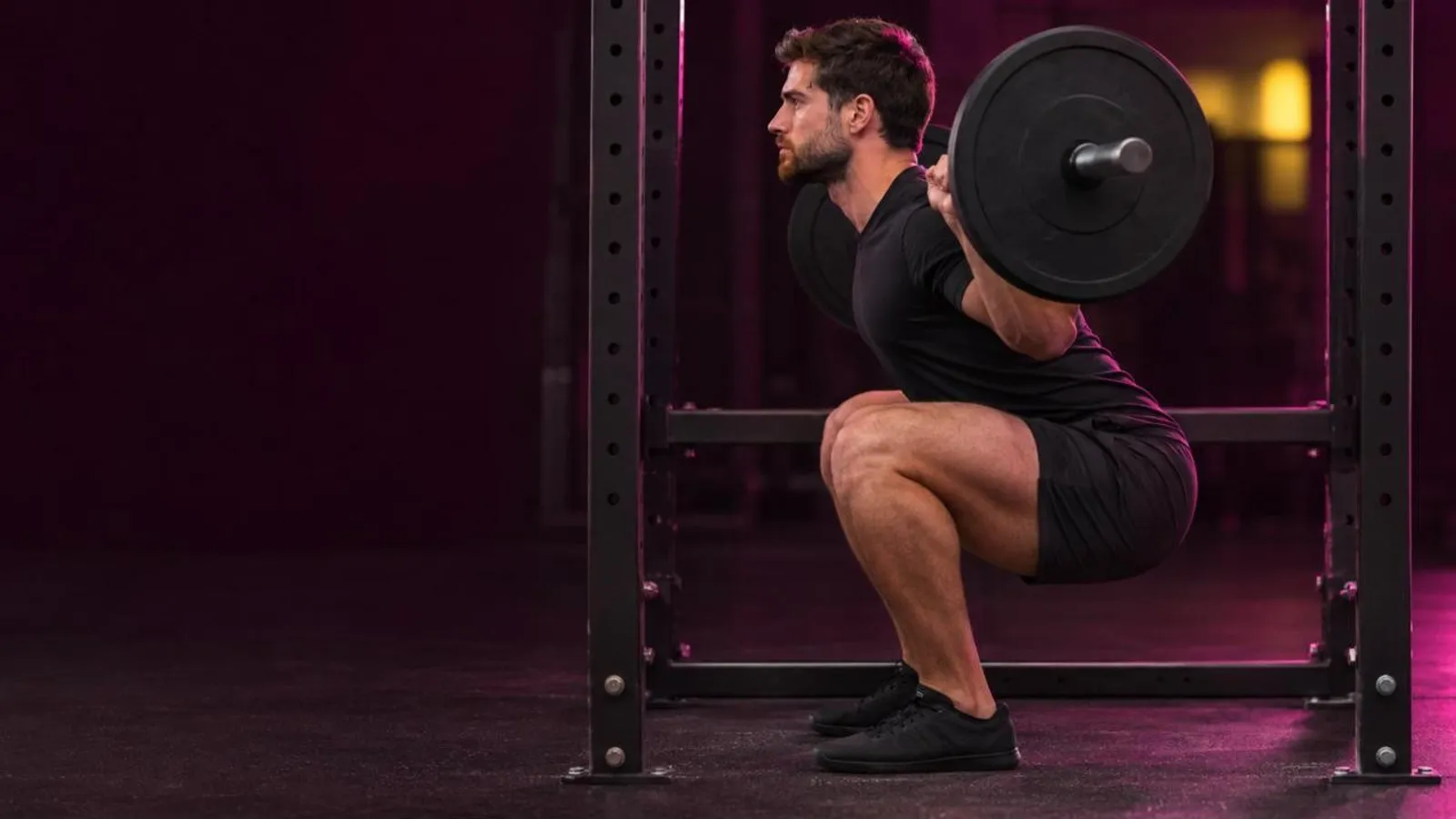
Squat depth describes how far you descend during the movement.
You’ll often hear terms such as:
- Quarter squat
- Half squat
- Parallel
- Below parallel
- Full or deep squat
The problem is that people don’t always use those terms consistently.
Instead of becoming too focused on the label, look at what actually happens during your squat.
How far can you descend while maintaining a stable, controlled movement?
And can you repeat that depth across the set?
Those questions are usually more useful.
Do you have to squat below parallel?
No single depth is mandatory for every person and every training goal.
If you’re competing in a sport such as powerlifting, competition rules determine the depth you need to achieve.
General strength training is different.
You’re not automatically performing a bad squat because you didn’t cross a particular imaginary line.
At the same time, consistently cutting your squat short simply because a heavier weight is easier to move through a smaller range isn’t necessarily useful either.
Choose your depth deliberately rather than letting the load decide it for you.
Is a deeper squat better?
Not automatically.
A deeper squat uses a greater range of motion, which can be useful when you can perform it appropriately.
But deeper isn’t better at any cost.
Suppose you can squat to a certain depth while:
- Keeping your feet stable
- Maintaining control
- Moving without pain
- Reversing the movement confidently
Then you descend another few centimetres and suddenly:
- Your heels lift
- You lose balance
- Your position changes substantially
- You can’t control the bottom
Simply going lower hasn’t necessarily improved the rep.
Use the range of motion you can perform well.
Then, if increasing that range is relevant to your goals, work on it gradually.
Your proportions affect how your squat looks
Two people can perform good squats that look noticeably different.
Your relative torso, thigh and lower-leg lengths influence how your body moves when you squat.
Someone with relatively long thighs may need more forward torso lean than someone with different proportions.
Stance width and foot angle can also change the movement.
This is why copying the exact squat position of somebody you saw online isn’t always helpful.
Their squat belongs to their body.
Yours needs to work with yours.
Your squat variation matters too
Not every squat is the same exercise.
Compare:
- Back squat
- Front squat
- Goblet squat
- Hack squat
- Smith machine squat
- Bodyweight squat
Each changes the demands and constraints of the movement.
The depth you comfortably achieve in a goblet squat may not be identical to the depth you use with a heavy barbell back squat.
So when you’re assessing your depth, compare like with like.
Don’t assume every squat variation has to look identical.
What should happen at the bottom?
The bottom position shouldn’t feel like somewhere you accidentally fell into.
You should have enough control to reverse the movement and stand back up.
When reviewing your squat, look at:
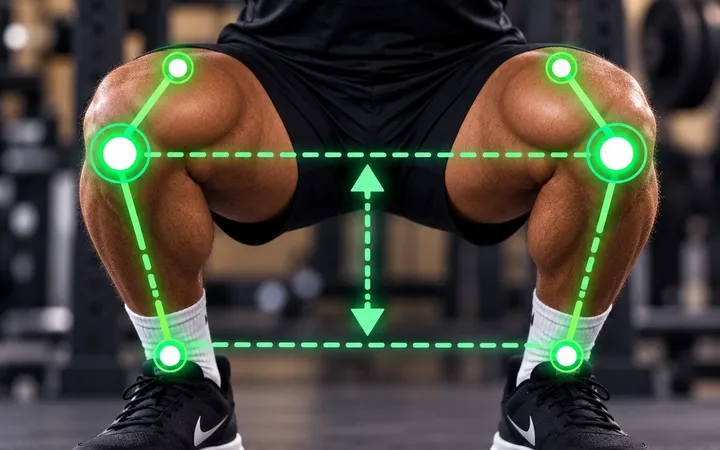
Feet
Do your heels remain in contact with the floor?
Are your feet reasonably stable?
Do they continue moving in a controlled way relative to your stance?
Do they stay roughly in line with your feet as you reach the bottom?
Hips
Do your hips keep travelling down at a steady speed, or do they suddenly drop and bounce?
Back
Does your trunk stay in a similar position, or does it change sharply in the last few centimetres?
Balance
Is your weight spread across your whole foot, or do you tip onto your toes or rock onto your heels?
If those stay steady, you’re in a position you can control.
If one of them changes sharply only at the very bottom, that point is probably the end of the range you currently own.
How to find the right depth for you
You don’t need a special test. You need a light weight and a camera.
- Use bodyweight or a load that feels easy.
- Squat slowly and stop at the point where you’re still in control.
- Record the set from the side, with the camera at roughly hip height.
- Watch the bottom of each rep. Where do your feet, knees, hips and back stay steady, and where do they start to change?
- Use the deepest position that stays steady as your working depth.
That depth becomes your reference.
When you add weight or try a new variation, compare against it.
Does your depth change as the weight goes up?
It’s common to squat to a consistent depth with lighter weights and then, without noticing, get shallower as the load increases.
Squatting higher on a heavy set isn’t automatically a problem if you’ve chosen to.
But if the weight is quietly deciding your depth, that’s worth knowing.
If your depth has crept up since you last added weight, hold the load where it is until your usual depth comes back.
If it doesn’t come back, reducing the weight for a while and rebuilding is often the quicker route.
Does your depth change across a set?
Look at your last two or three reps, not just the first.
The first reps of a set often reach your usual depth.
Then fatigue builds, and the final reps get a little shorter each time.
A small change is normal.
A clear drop-off tells you where the set stopped being the exercise you planned.
You can respond by stopping the set a rep or two earlier, or by using a slightly lighter weight next time. Shrinking depth is one of the common squat mistakes worth checking for.
Is squatting deep bad for your knees?
Squatting deep isn’t automatically bad for your knees.
What matters more is whether you can control the depth you use, whether you’ve built up to it gradually and whether it’s comfortable for you.
If squatting at any depth causes pain, swelling or a feeling that your knee is unstable, stop and get advice from a physiotherapist or GP.
Don’t push through pain to reach a depth you’ve read about.
How can you improve your squat depth?
If going deeper is relevant to your goals, build it gradually.
- Use a variation that makes depth easier. A goblet squat, with the weight held in front of your chest, often makes the bottom position easier to reach and control.
- Slow the descent. Lowering over two or three seconds gives you time to feel where control starts to fade.
- Adjust your stance. A slightly wider stance or slightly more turned-out feet can change how deep you comfortably go.
- Try raising your heels. Small plates under your heels, or squat shoes with a raised heel, help some people reach depth while keeping their feet flat.
- Spend time at the bottom. Holding a supported squat for a few breaths, gripping a doorframe or a rack, helps you get used to the position.
- Add depth a little at a time. A few centimetres over several weeks, not in one session.
Then record another set and compare it with your reference.
The right depth is the one you can control
There isn’t a single correct depth.
There’s the depth that suits your goal, your body and the squat you’re doing, and that you can control from the first rep to the last.
Find it. Record it. Then watch whether it stays the same as the weight and the reps go up.
See your depth on every rep
Depth is hard to judge while you’re in the squat, and it’s easy to miss a rep that cut short.
On supported lifts, including the bodyweight squat, Trayner Form Check scores every rep of a recorded set, including how deep you went, and shows where your depth stays consistent and where it starts to change.
That gives you something specific to check on your next set.