Bench Press Form: 7 Things to Check on Every Rep
Good bench press form isn't one perfect rep. Here are seven things to check across a set, from how you set up on the bench to what changes on your last two reps.
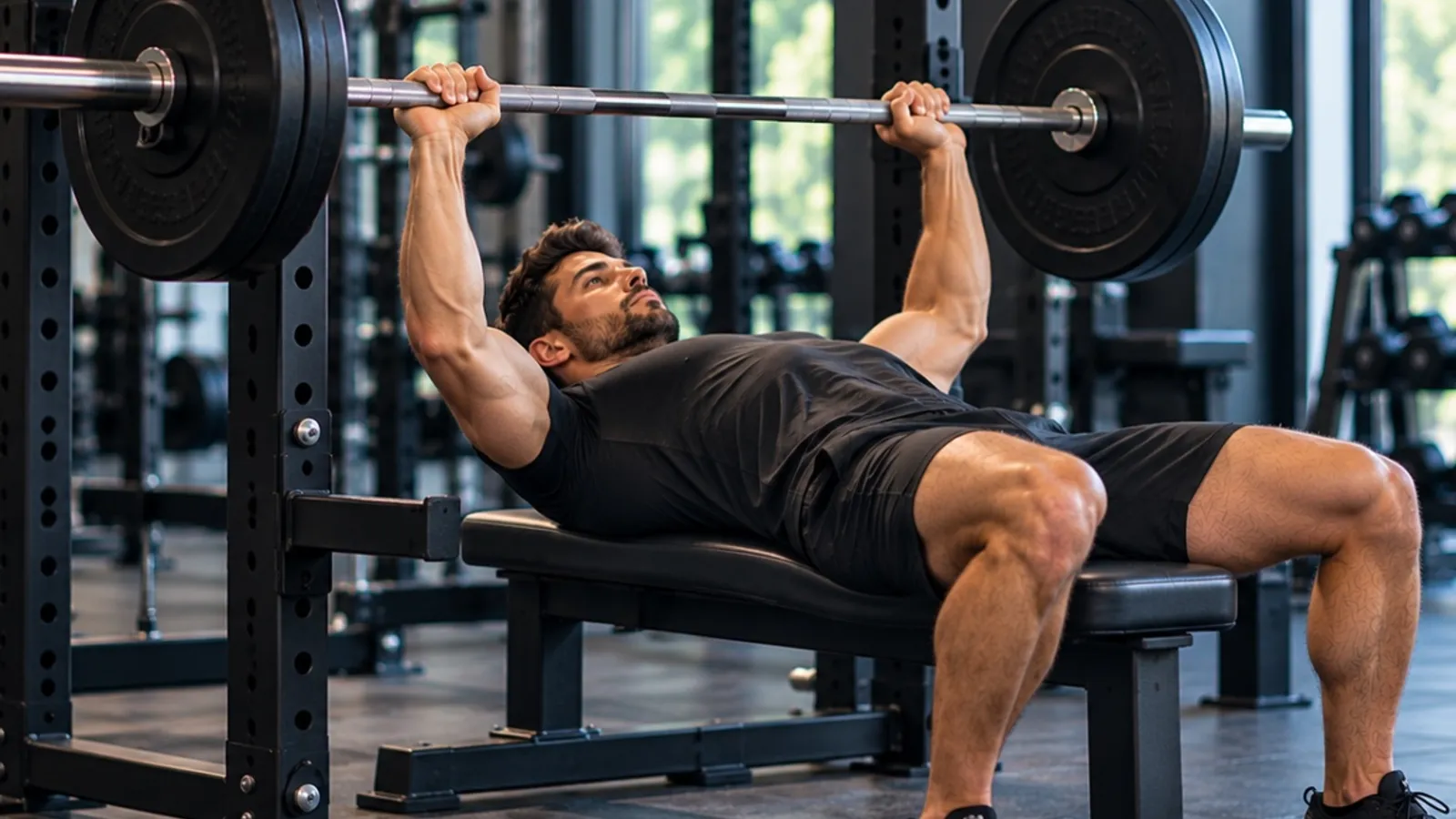
The bench press looks like one of the simplest lifts in the gym.
Lie down, lower the bar, press it back up.
But a lot happens between the first rep and the last. Your shoulders can drift off the bench. The bar can land somewhere different each time. Your hips can lift as the set gets hard.
So what does good bench press form look like?
In short: a stable set-up, a grip and wrist position you can hold, a bar that travels the same way every rep, and a set where your last reps still look like your first.
It’s the same idea as our squat form checklist: watch the whole set, not just your best rep.
Here are seven things worth checking.
1. Your set-up is the same every time
Most bench press problems start before the bar moves.
Before you unrack, you want a position you can repeat. A common way to describe it is five points of contact:
- The back of your head on the bench
- Your upper back and shoulders on the bench
- Your bottom on the bench
- Your right foot on the floor
- Your left foot on the floor
Many lifters also pull their shoulder blades back and down before they unrack, so their upper back feels tight and stable against the bench. A small, natural arch in the lower back is normal.
The detail matters less than the consistency.
If you set up differently every session, it’s hard to know whether a bad rep came from the press or from where you started.
Check for:
- Your eyes roughly under the bar when you lie down
- Shoulders set before you unrack, not halfway through the set
- Feet in the same place each time
2. Your grip and wrists stay stacked
Grip width changes how the press feels and which muscles do more of the work.
There isn’t one correct width. The American Council on Exercise describes a grip slightly wider than shoulder-width as the starting point, and most people bench somewhere around there.
What’s worth checking is your wrists.
Ideally, the bar sits low in your palm, over your forearm, rather than up near your fingers with your wrist bent back.
When the wrist folds back, the weight sits behind your forearm instead of on top of it. Under a heavy bar, that tends to feel unstable and uncomfortable.
Check for:
- Wrists roughly straight, not bent far back
- Forearms close to vertical at the bottom of the rep, seen from the front
- Both hands the same distance from the centre of the bar
That last one is easy to miss. If one hand is a finger-width further out, the bar can tilt or drift to one side.
3. The bar travels the same path
Watch the bar from the side and it usually doesn’t move straight up and down.
For most lifters, it comes down to the lower part of the chest, then travels up and slightly back towards the face as it’s pressed, finishing over the shoulders.
That’s normal.
You don’t need to force a perfect curve. You do want the path to look similar from rep to rep.
If one rep goes up and back, the next goes straight up, and the third drifts towards your stomach, something is changing. Often it’s your shoulders, your elbows or your touch point.
This is where filming the set helps. Bar path is almost impossible to judge from underneath the bar. Our guide to filming your bench press covers where to put the phone.
4. Your elbows aren’t flared out to the sides
As you lower the bar, watch the angle between your upper arms and your body.
Your elbows will move away from your sides to some degree. That’s how the press works.
But if your upper arms are close to straight out at 90 degrees, like a T shape, many lifters find their shoulders take more of the load and the press feels less stable.
If they’re tucked tight against your ribs, the bar often ends up too low on your stomach.
Most people end up somewhere in between: elbows a little way out from the body, forearms under the bar.
A useful question:
Do your elbows stay in roughly the same position on every rep, or do they flare out further as the set gets harder?
A change across the set tells you more than one frozen frame.
5. The bar touches the same spot
Where the bar meets your chest is your touch point.
For most people, it’s somewhere around the lower chest, though grip width, arm length and how much you arch all change it.
What matters is that it’s consistent.
If the bar touches your lower chest on rep one, near your collarbones on rep four and your upper stomach on rep six, you’re doing three slightly different lifts in one set.
Also check how the bar arrives.
A controlled touch is different from letting the bar drop and bounce off your chest. Bouncing makes the bottom of the rep harder to control and harder to repeat.
Check for:
- A similar touch point on every rep
- A brief, controlled touch rather than a bounce
- No obvious pause in one rep and none in the next, unless you’re doing paused reps on purpose
6. Your feet and hips stay put
Your legs do more on the bench than people expect.
The ACE chest press instructions put it simply: press the feet into the ground and the hips into the bench.
Pushing your feet into the floor, often called leg drive, helps keep your body stable and your upper back pinned to the bench.
What you’re watching for is movement that shouldn’t be there:
- Your bottom lifting off the bench as you press
- Feet sliding, lifting or shuffling between reps
- Your whole body shifting up or down the bench during the set
If your hips lift on the hardest reps, it’s often a sign the weight is close to your limit. It also changes the lift: with your bottom off the bench, you’re pressing from a different angle from the rest of the set.
7. Your last reps still look like your first
This is the most useful thing to check.
Your first rep is usually your best. You’re fresh, and your set-up is still tight.
The real information is at the end of the set.
Suppose you do eight reps.
- Reps 1–5: same touch point, same bar path, elbows steady
- Rep 6: elbows flare a little further
- Rep 7: the bar touches higher on the chest and drifts towards your face
- Rep 8: hips lift slightly off the bench to finish
That doesn’t mean the set was bad.
It tells you where your form started to change, and which part changed first.
That’s something you can work with. It might mean the weight is right for six good reps rather than eight. It might mean your shoulders aren’t staying set. Either way, you know what to look at next time.
What about the dumbbell bench press?
The same checks apply, with a few differences.
Each arm works on its own, so the dumbbells can drift apart or tip. Lower them under control to the sides of your chest, keep your wrists stacked over your elbows, and press back up so they finish over your shoulders rather than knocking together.
Dumbbells usually let you lower a little deeper than a barbell. That only helps if your shoulders stay comfortable, so go as low as you can while your shoulder blades stay set on the bench.
Getting into position is the hard part with heavier dumbbells. Sit on the end of the bench with them resting on your thighs, then lie back and bring them up together with your knees. When you finish, bring them back to your chest and sit up the same way, rather than dropping them out to the sides.
If you train alone, the dumbbell bench press is a good choice: you can put the weights down safely without a spotter.
The same checks apply on an incline bench, with the bar touching higher on your chest. Our incline bench press guide covers the angle and the differences.
How to improve your bench press form
Change one thing at a time.
If your set-up varies, write down where your eyes, hands and feet go, and copy it every session.
If your form changes on the last two reps, try the same weight for fewer reps, or keep the reps and hold the weight where it is until every rep looks like the first. If you’d rather reduce the weight, our 1RM calculator gives a rough idea of a load that suits your target reps.
If the bar path is all over the place, film from the side and slow the lowering phase down. A two or three second descent makes it easier to feel where the bar lands.
Then film again and compare.
Do you need a spotter?
If you’re pushing close to failure on the bench press, use a spotter or set the safety arms in a rack at a height just below your chest.
A missed squat can be dumped behind you. A missed bench press ends up on your chest or neck.
That isn’t a form point, but it’s the first thing to sort out before you push any set hard.
When should you get help?
Some discomfort in the chest, shoulders and arms after a hard session is normal.
Pain is different.
If you notice:
- Sharp pain in the shoulder, chest, elbow or wrist during the lift
- Pain that lasts for days after training
- Clicking or catching that comes with pain
- Weakness or pain after a specific rep
stop pressing through it and get advice from a physiotherapist or your GP.
A video can show you how you moved. It can’t diagnose why something hurts.
Film the set, then check the reps
It’s hard to watch your own bar path, elbows and hips while you’re under the bar.
Trayner Form Check grades the barbell bench press. Film your set from a three-quarter angle and you get a score for each rep, a note on what happened and the fix. If it couldn’t score the set, it tells you why and which angle to film next time.
So you leave with something specific to work on, not just a feeling that the last rep was ugly.