Why Do Your Knees Cave In When You Squat?
Notice your knees moving inward when you squat? Learn what to look for, why it may become more noticeable as a set gets harder, and what you can do next.
You watch your squat back and notice something.
As you start standing up, one or both knees move inward.
It’s often called knee cave, and you may also hear the term knee valgus.
Seeing it doesn’t automatically mean something is injured or that every inward movement is dangerous. Knees can move during a squat, and human movement isn’t perfectly fixed.
The more useful questions are:
How much are your knees moving? When does it happen? Is it getting more noticeable as the set continues? And can you control it?
Here’s what to look for.
What does knee cave look like?
Watch yourself from the front or at an angle.
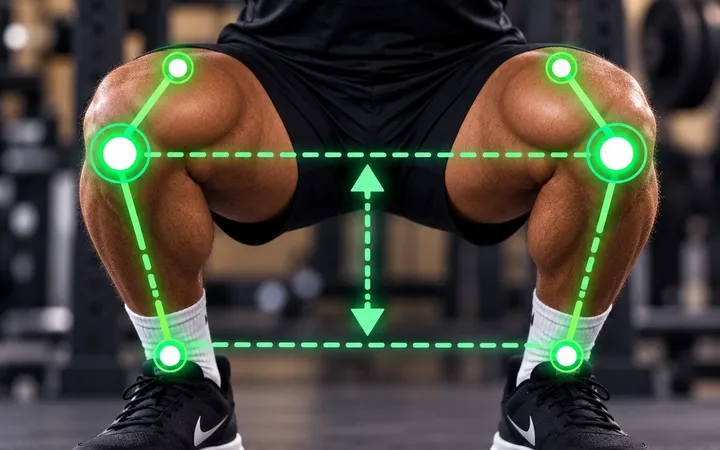
As you descend or stand up from the squat, you may see your knee move inward relative to your foot.
Sometimes both knees move.
Sometimes one side moves much more than the other.
And sometimes everything looks consistent until the final few reps.
For example:
- Rep 1: stable
- Rep 2: stable
- Rep 3: stable
- Rep 4: slight inward movement
- Rep 5: more noticeable
- Rep 6: significant change
That pattern tells you something important.
The movement isn’t simply present.
It’s changing as the set becomes harder.
Why might your knees move inward?
There isn’t one universal reason.
That’s important because it’s tempting to watch a video and immediately decide:
“My glutes are weak.”
or:
“My ankles aren’t mobile enough.”
A video alone usually can’t tell you that.
Several things can influence what you see.
1. The set is getting difficult
Start with the simplest possibility.
Look at when the movement happens.
If your knees track consistently through the first six reps but start moving inward on reps seven and eight, fatigue or effort may be playing a role.
Your body is trying to finish increasingly difficult repetitions.
That’s different from seeing the same movement on every rep from the beginning of the set.
Instead of immediately searching for a corrective exercise, ask:
Does this happen when I’m fresh, or only when I’m approaching my limit?
That’s useful context.
2. The weight may be affecting your control
Now compare different loads.
Suppose you squat:
60 kg: movement stays consistent.
70 kg: slight inward movement on the final rep.
80 kg: knees move noticeably inward across several reps.
Again, that gives you useful information.
It doesn’t prove why the movement is happening.
But it does show that the amount of load changes what you’re able to control.
If increasing the weight causes a large change in how you’re performing the exercise, consider whether the increase was appropriate.
Sometimes the useful adjustment isn’t a new exercise.
It’s simply using a load you can control.
3. Your stance may not suit you
There isn’t one universal squat stance.
Your foot position, stance width, proportions and individual anatomy all influence how your squat looks.
Copying somebody else’s exact foot position doesn’t guarantee it will work for you.
Experiment within a comfortable range.
You may find that a small adjustment to stance width or toe angle makes it easier for your knees and feet to move together.
The goal isn’t to force your knees into an artificial position.
It’s to find a stance that lets you squat comfortably and consistently.
4. Your feet may be moving too
Don’t look only at your knees.
Look further down.
What are your feet doing?
Are your heels staying down?
Are your feet rolling significantly towards the inside?
Does one foot behave differently from the other?
The knee is one part of a movement involving your feet, ankles, hips and the rest of your body.
Zooming in on the knee while ignoring everything around it can hide useful information.
When reviewing a squat, watch the whole movement.
5. Your overall position may be changing
Your knees may not be the only thing that changes as the set gets harder.
You might also notice:
- Your hips shifting
- Your torso angle changing
- Your depth decreasing
- Your feet becoming less stable
- Your tempo becoming faster
- More weight shifting towards one side
These changes together tell you much more than the knee movement alone.
If several things start changing on the same rep, you may simply be reaching the point where maintaining your previous technique becomes difficult.
Is knee cave always bad?
Not necessarily.
A small amount of movement isn’t automatically evidence of an injury or a dangerous squat.
Real human movement contains variation.
That’s why simply freezing a video at the moment your knee moves slightly inward and drawing lines across the screen can be misleading.
Look at the degree, timing, consistency and context instead.
There’s a meaningful difference between:
A small amount of inward movement during a difficult repetition
and:
A large, uncontrolled change that becomes more pronounced across the set.
The second is more useful to investigate.
What should you do if your knees cave in?
Start with observation before correction.
Step 1: Record the set
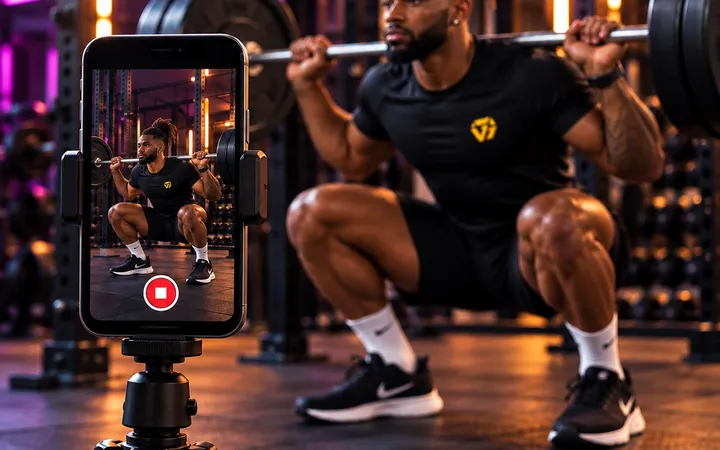
Film yourself from the front or around a 45-degree angle.
Make sure your feet, knees and hips remain visible.
Step 2: Watch every rep
Don’t judge the entire exercise from one screenshot.
Compare your first rep with your last.
Step 3: Look for a pattern
Ask:
- Does it happen on both sides?
- Does one knee move more?
- Does it happen during the descent or ascent?
- Does it only happen near the end of the set?
- Does it change when the weight increases?
- What else changes at the same time?
Step 4: Adjust one thing
If the movement becomes much more noticeable when the weight is heavy, try a manageable reduction in load and compare.
If you’re unsure about your stance, experiment with a small adjustment.
If you’re rushing your reps, try maintaining more control.
Change one variable at a time.
Otherwise, you won’t know what made the difference.
Don’t force your knees out as far as possible
You’ve probably heard the cue:
“Push your knees out.”
That can be useful for some people in some situations.
But it’s not a rule that your knees should be forced as far outward as possible throughout every squat.
The goal isn’t:
knees out = good
knees in = bad
Your knees should be able to move naturally with your stance and feet while you maintain control.
A cue is useful when it improves the movement you’re trying to perform.
It isn’t useful simply because it’s a popular gym instruction.
What about strengthening exercises?
You may see recommendations for banded squats, glute exercises, hip strengthening or mobility drills.
Those exercises can have a place in training.
But seeing your knee move inward doesn’t automatically tell you which one you need.
Before adding a collection of corrective exercises, establish what actually happens during your squat.
If the movement only appears when you attempt a load that’s currently too demanding, the first solution may simply be managing the load.
If it appears consistently regardless of weight and concerns you, getting an individual assessment may be more useful than guessing at the cause.
What if only one knee moves inward?
Pay attention to repeated side-to-side differences.
If one knee consistently moves much more than the other, look at the rest of the movement too.
Does your hip shift?
Does one foot move differently?
Are you loading one side more heavily?
Again, don’t diagnose the cause from the video.
But a consistent asymmetry gives you something specific to observe and, if necessary, discuss with a qualified professional.
When should you get help?
A video can help you identify a movement pattern.
It can’t diagnose an injury.
If the knee movement is accompanied by:
- Pain
- Swelling
- Instability
- A recent injury
- Persistent discomfort
or you’re otherwise concerned about it, seek advice from an appropriately qualified healthcare professional.
Don’t use a form video or an AI form checker to diagnose a medical problem.
Look for change, not perfection
The useful question isn’t:
“Did my knee move inward at all?”
It’s:
“What happens to my knee movement as I squat, and does that change across the set?”
Maybe every rep stays consistent.
Maybe the movement appears only when you get tired.
Maybe it becomes more noticeable as the weight increases.
Those patterns give you information you can actually use.
Your squat doesn’t need to look like a perfectly animated model.
It needs to be a movement you can perform with appropriate control — and one you can understand when that control starts to change.
See where your form starts to change
It’s difficult to track your knees, hips, depth and tempo while you’re concentrating on the lift.
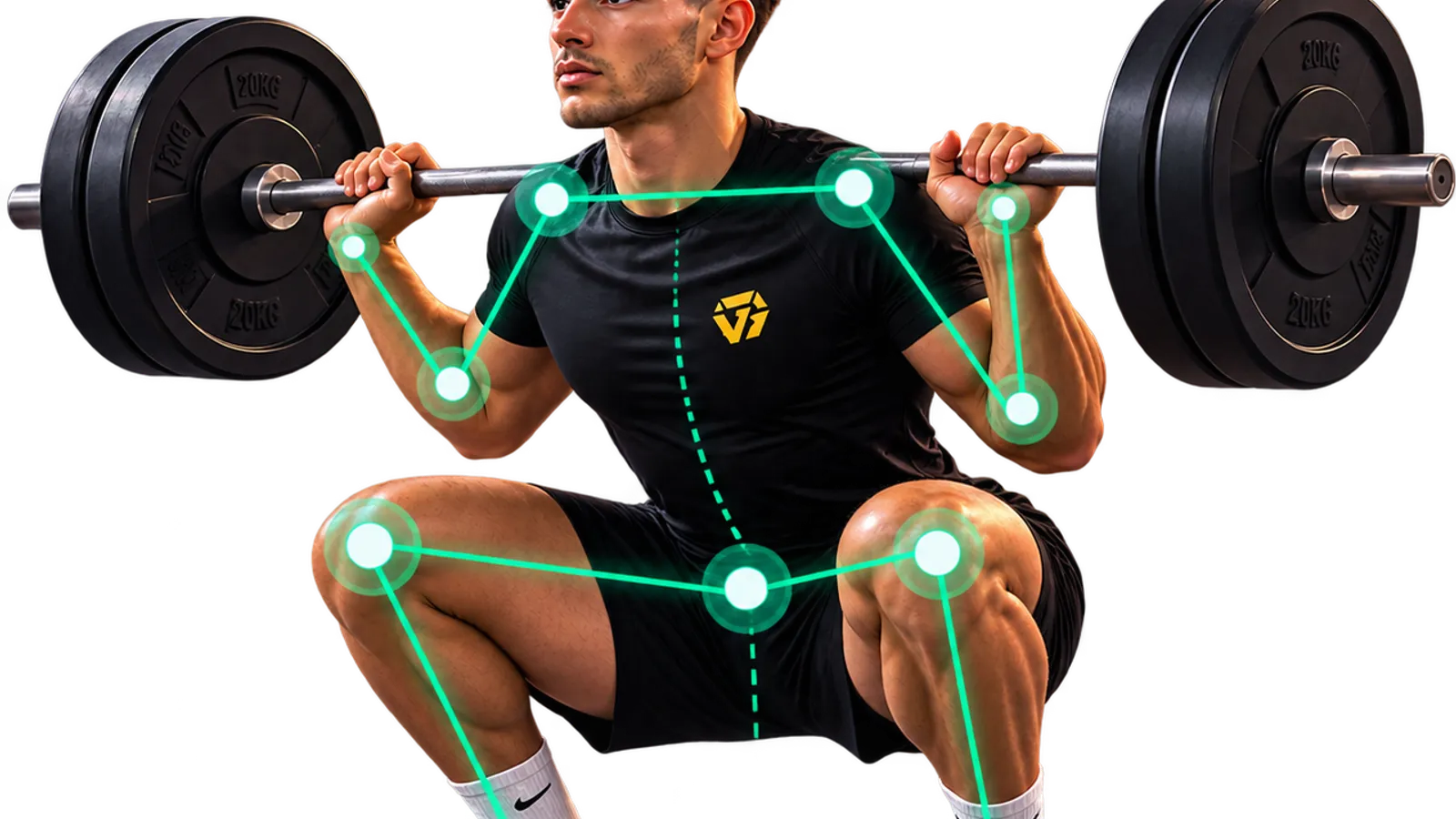
On supported lifts, including the bodyweight squat, Trayner Form Check analyses your recorded set across your reps and helps highlight where your movement stays consistent and where it begins to change.
That gives you something specific to pay attention to on your next set.