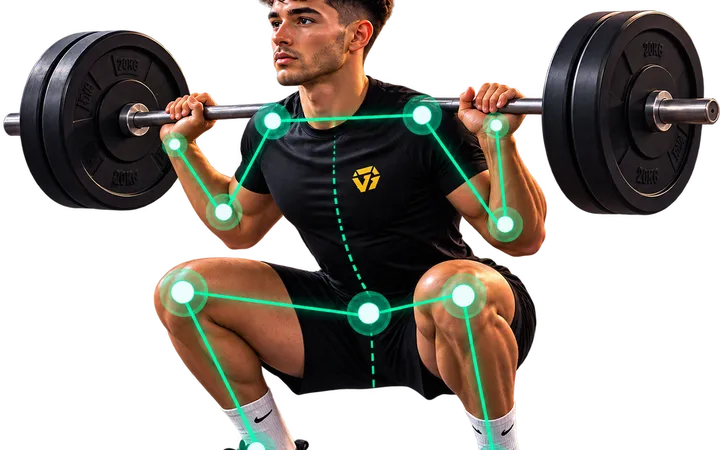
Squat Form: 7 Things to Check on Every Rep
Your squat doesn't need to look perfect. Here are seven things to watch across your reps to understand where your form stays consistent — and where it starts to change.
Squats can look simple from the outside: lower yourself down, then stand back up.
But once you add weight, small changes can creep in. Your knees may start moving differently. Your heels might lift. You might rush the bottom of the rep or shift more weight onto one side.
Good squat form isn’t about making every rep look identical. Bodies, proportions and squat styles differ. What matters is that your movement stays controlled, repeatable and appropriate for you.
Here are seven things worth checking.
1. Your feet stay planted
Start with the part of you that’s connected to the floor.
Your whole foot should feel stable throughout the squat. That doesn’t mean your weight has to be distributed perfectly evenly at every moment, but you shouldn’t be noticeably rolling onto the inside or outside of your feet.
Pay particular attention to your heels.
If they repeatedly lift as you descend, it may be a sign that you’re struggling to maintain your chosen position or depth.
Check for:
- Heels staying in contact with the floor
- Feet remaining stable rather than rocking
- No obvious shift onto one side
Your stance doesn’t need to match someone else’s. Some people squat comfortably with their feet relatively straight, while others prefer their toes turned slightly out.
The important question is whether your stance lets you move comfortably and consistently.
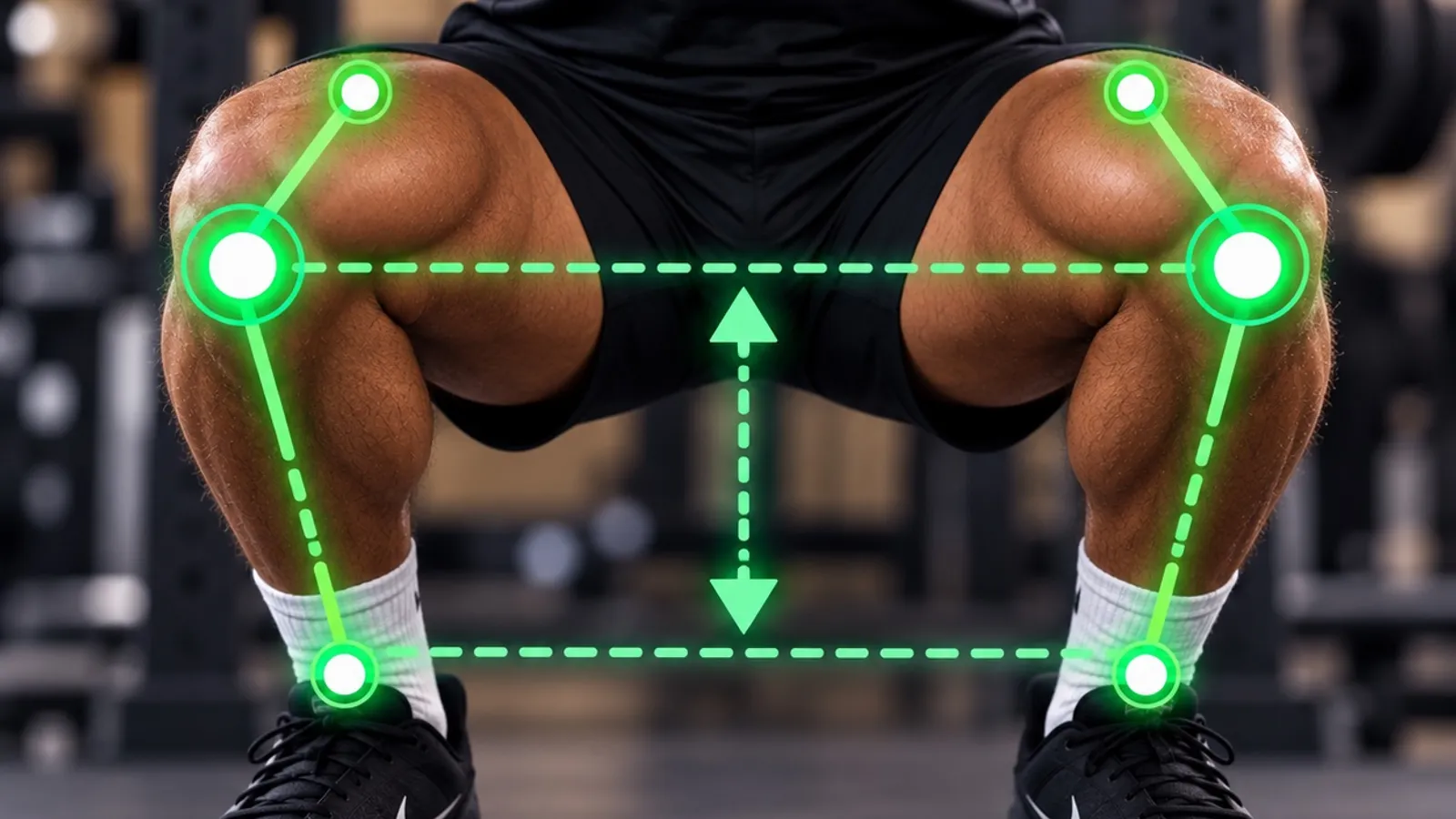
2. Your knees track with your feet
Watch what your knees do as you descend and stand back up.
They should generally move in the same direction as your feet rather than suddenly collapsing significantly inwards or shifting unpredictably.
A small amount of knee movement isn’t automatically a problem. Human movement isn’t perfectly rigid.
What matters more is whether there’s a noticeable loss of control, particularly as the set becomes difficult.
For example, your first four reps might look consistent, but your knees begin moving sharply inward on reps five and six.
That’s useful information.
It may tell you more than simply looking at your best rep.
3. Your torso stays controlled
Your torso will lean forward to some degree when you squat.
That’s normal.
How much depends on factors including your proportions, stance, squat variation and the load you’re using.
Rather than trying to keep your back perfectly vertical, look for control and consistency.
If your torso angle suddenly changes as you come out of the bottom — particularly as you become tired — the movement may be starting to break down.
Compare your reps.
If rep one and rep eight look completely different, ask what changed.
4. You reach a depth you can control
There’s no single squat depth that everyone has to reach.
Your mobility, proportions, experience, exercise variation and goals all matter.
Instead of chasing depth at any cost, aim for a range of motion you can control.
Watch what happens near the bottom.
Can you maintain your position?
Do your heels stay down?
Can you reverse the movement without collapsing or losing balance?
And importantly, is your depth reasonably consistent from rep to rep?
If your first few reps are deep but each subsequent rep becomes noticeably shallower, fatigue may be changing how you’re performing the exercise.
That’s worth noticing.
5. Your hips don’t shift noticeably to one side
Watch yourself from the front or rear and look at how your hips move.
A small amount of natural asymmetry is common. You’re not trying to turn yourself into a perfectly symmetrical diagram.
You’re looking for an obvious or increasing shift.
For example:
- Rep 1: centred
- Rep 2: centred
- Rep 3: slight shift
- Rep 4: noticeable shift
- Rep 5: larger shift
That pattern is more useful than judging a single frame from a single rep.
If you repeatedly experience a pronounced shift, especially alongside pain or discomfort, consider getting it assessed by an appropriately qualified professional rather than trying to diagnose the cause from a video.
6. You control the descent
Dropping quickly into the bottom of a squat can make it harder to maintain a consistent position.
You don’t necessarily need to squat slowly.
You do want the descent to look intentional.
Watch several reps together.
If the first few have a controlled rhythm but later reps suddenly become much faster on the way down, fatigue may be affecting your control.
A useful question is:
Could you stop the movement if you needed to?
If the answer is no because you’re effectively falling into the bottom position, reducing the load or slowing the descent may help you regain control.
7. Your last reps still resemble your first
This is one of the most useful things to watch.
Don’t judge your squat from one perfect repetition.
Watch the entire set.
Your first rep might look excellent because you’re fresh. The more interesting information often appears towards the end.
Look for changes in:
- Depth
- Knee movement
- Balance
- Torso position
- Hip movement
- Tempo
- Overall control
Suppose you perform eight reps.
The first six are consistent, but on seven and eight your depth decreases and your knees start moving inward.
That doesn’t necessarily mean your entire set was poor.
It tells you where your form started changing.
And that gives you something useful to work with.
How to check your own squat form
You don’t need a complicated camera setup.
Place your phone somewhere stable and record the full set.
A roughly 45-degree view can be useful because it lets you see several parts of the movement at once. A side view can make depth and torso movement easier to see, while a front view can help reveal side-to-side movement and how your knees are tracking.
Make sure your whole body remains visible throughout the exercise.
Then watch the set back.
Don’t immediately look for everything that’s “wrong”.
Start by asking:
What changed between my first rep and my last?
That often gives you a much clearer place to start.
It’s difficult to watch your own movement while you’re concentrating on the lift. On supported lifts, including the bodyweight squat, Trayner Form Check can analyse your recorded set, look across your reps and help highlight where your movement starts to change — so you know what to pay attention to next time you train.
Don’t chase a perfect-looking squat
There isn’t one squat position that every person needs to copy.
Someone with different limb lengths, mobility or training goals may squat differently from you while still moving effectively.
The aim isn’t to make your squat look like somebody else’s.
It’s to develop a squat that is controlled, repeatable and suitable for what you’re trying to achieve.
And when something does start changing, notice it.
That’s where useful feedback begins.