Should You Train When You're Still Sore?
Being sore doesn't automatically mean you need a rest day. Here's how to use soreness, movement and training performance to decide whether to train, adjust your session or recover.
You trained legs two days ago.
Today is another training day, but walking downstairs is reminding you exactly what you did.
Should you train anyway?
Muscle soreness doesn’t automatically mean you need to skip your workout. But it also isn’t something you need to prove you can push through.
The better question is:
How sore are you, how are you moving, and what are you planning to train today?
Here’s how to decide.
Why are your muscles sore after training?
The soreness you feel after exercise is commonly called delayed onset muscle soreness, or DOMS.
It often appears after unfamiliar or demanding training and can become more noticeable over the following day or two.
You may notice it particularly when you’ve:
- Started training again after time away
- Tried a new exercise
- Increased your training volume
- Increased the difficulty of your workout
- Performed movements your body isn’t accustomed to
DOMS can make a muscle feel tender, stiff or uncomfortable when you move it.
That doesn’t necessarily mean you’ve injured it.
And importantly, being sore isn’t proof that you had a better workout.
Soreness isn’t the same as progress
It’s easy to treat soreness like a score.
Very sore = great workout.
Not sore = didn’t work hard enough.
Training doesn’t work that neatly.
As you become accustomed to your programme, you may experience less soreness even though your training is still productive.
You can get stronger without struggling to sit down after every leg session.
Don’t chase soreness.
Chase training you can perform consistently and recover from.
Can you train while you’re sore?
Sometimes, yes.
Mild muscle soreness doesn’t automatically require a rest day.
Suppose your chest feels slightly sore from your previous session, but today you’re training legs.
You’re moving normally, you otherwise feel well and the soreness isn’t affecting the exercises you’re planning to perform.
There may be little reason for that mild soreness alone to stop you training.
But the situation changes when the soreness affects the muscles you’re about to train or changes how you’re moving.
That’s when you need more context.
Start with how sore you actually are
Don’t reduce it to:
Sore or not sore.
Think about the degree.
Mild soreness
You can feel that you trained, but:
- Normal movement is comfortable
- Your range of motion is largely unaffected
- You aren’t changing how you walk or move
- The muscle feels mildly tender rather than painful
You may be able to train normally, depending on what you’re doing.
Moderate soreness
The soreness is obvious.
You may feel stiff, and certain movements are uncomfortable.
Training may still be possible, but pay attention to your warm-up and how your performance feels before deciding how hard to push.
Severe soreness
Normal movement is significantly uncomfortable.
Your range of motion may be reduced, you’re moving differently to compensate or the muscle feels extremely tender.
That’s a different situation.
Forcing a demanding session for the same muscles simply because it’s written on your programme may not be useful.
Your plan should guide your training.
It doesn’t need to overrule what your body is clearly telling you.
Use your warm-up as information
You don’t always have to decide before you arrive at the gym.
Start your warm-up.
Move.
Perform some lighter sets.
Then reassess.
Sometimes mild stiffness improves as you warm up and you feel completely capable of completing your planned session.
Other times, the warm-up confirms that you’re not moving normally or your performance is clearly below where it usually is.
That’s information.
Don’t ignore it simply because today’s programme says:
Squat — 4 × 8.
You can adjust.
Check whether your movement has changed
This matters.
Imagine your legs are very sore and you’re squatting.
To avoid the discomfort, you start:
- Squatting noticeably shallower
- Shifting your weight
- Moving much more slowly
- Changing your stance
- Favouring one side
Now soreness isn’t just something you can feel.
It’s changing the exercise.
If you can’t perform the movement with reasonable control because of soreness, reducing the load, changing the exercise or giving those muscles more recovery may make more sense.
Check your performance too
Your normal working weight can give you useful feedback.
Suppose you usually squat:
80 kg × 8
During today’s warm-up, even substantially lighter weights feel unusually difficult.
That doesn’t automatically mean you have to leave the gym.
But combined with significant soreness, it suggests you may not be as recovered as usual.
You could:
- Reduce the load
- Reduce the number of sets
- Train a different muscle group
- Choose a less demanding session
- Take another recovery day
Training doesn’t have to be all or nothing.
Can you train a different muscle group?
Often, this is the simplest option.
If your legs are sore but your upper body feels fine, an upper-body session may be completely reasonable.
This is one reason training programmes often distribute work across different muscle groups and days.
You’re not necessarily choosing between:
Full planned workout
and
Do absolutely nothing.
You may simply change what you’re training.
Should you do light exercise when you’re sore?
Gentle movement can feel good when you’re sore.
Walking, easy cycling or other low-intensity activity may help you feel less stiff.
But don’t turn a recovery session into another hard workout because you think you need to “flush out” the soreness.
If recovery is the goal, keep the activity easy enough that it doesn’t create another substantial recovery demand.
Should you stretch sore muscles?
Gentle stretching may feel comfortable for some people, but you don’t need to aggressively stretch a sore muscle to make it recover.
More intensity isn’t necessarily more helpful.
If a stretch hurts, forcing yourself further into it isn’t a recovery strategy.
Use comfortable movement rather than trying to punish the soreness away.
What about pain?
This is where the distinction matters.
Normal post-training muscle soreness is different from pain that feels sharp, sudden, localised or associated with an injury.
Stop and take the situation more seriously if you’re experiencing things such as:
- Sharp or severe pain
- Significant swelling
- Sudden pain during an exercise
- Loss of normal function
- Pain around a joint rather than general muscle soreness
- Symptoms that are worsening rather than settling
- Unexplained severe muscle pain or other concerning symptoms
Don’t use a blog article, workout tracker or recovery score to diagnose an injury.
If you’re concerned about pain or an injury, seek advice from an appropriately qualified healthcare professional.
What if you’re always sore?
Occasional soreness is one thing.
Being significantly sore after nearly every workout deserves a closer look at your training.
Ask:
Did I increase my volume too quickly?
Am I repeatedly training to my limit?
Did I introduce too many new exercises at once?
Am I giving myself enough time between demanding sessions?
Am I sleeping and eating enough to support the training I’m doing?
A programme isn’t effective simply because it’s difficult to recover from.
You need to be able to come back and train again.
Don’t use soreness as your recovery score
Soreness is one signal.
It isn’t the whole picture.
You might have very little soreness but be exhausted after several nights of poor sleep.
Or your muscles might be mildly sore while you otherwise feel rested and perform normally.
Recovery includes more than how tender your quads feel when you sit down.
Consider:
- Soreness
- Sleep
- General fatigue
- Training performance
- Motivation
- How you’re moving
- How demanding your recent training has been
No single number can perfectly tell you whether you’re ready.
Use the information together.
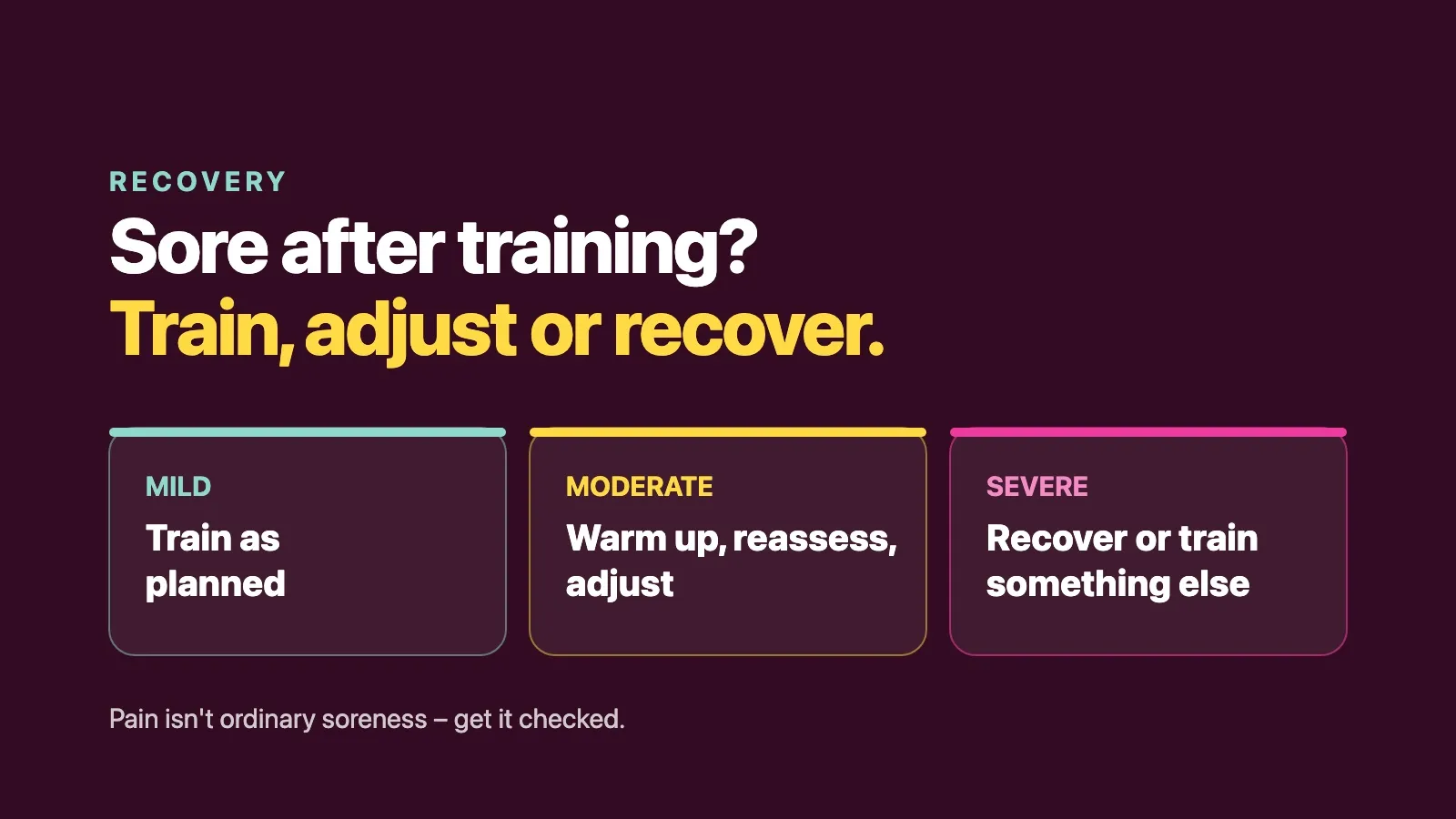
So, should you train when you’re sore?
A simple way to think about it:
Mild soreness + normal movement + normal performance
Training may be completely reasonable.
Moderate soreness + some stiffness or reduced performance
Warm up, reassess and consider adjusting the session.
Severe soreness + movement changes or major performance reduction
More recovery or a different training session may make more sense.
And:
Pain, injury symptoms or something that doesn’t feel like normal muscle soreness
Don’t treat it as ordinary DOMS.
The aim isn’t to prove that you can train regardless of how you feel.
It’s to make a useful training decision.
Sometimes that’s completing the workout exactly as planned.
Sometimes it’s reducing the load.
Sometimes it’s training something else.
And sometimes the productive thing to do is recover.
Training and recovery belong together
A workout doesn’t happen in isolation.
What you’ve trained recently, how you’ve recovered and what you’re ready for today all matter when deciding what to do next.
Trayner brings your training and recovery into the same picture, helping you see more than just what’s written on today’s workout.